I've had a bit of time to reflect on the impact of teaching during the age of Covid-19
Positives:
Some students have found this time to be really empowering. They have had the flexibility to organise their learning in a way that suits them and the support that they need to support this - through weekly video meets and also through one to one.
Some have struggled with the whole thing, but I feel with those who are struggling it is an amplification of issues/struggles they might have had face to face. It's important to point out that these students have still had support via one to one video calls which has helped them to move forwards a bit. I guess a positive is that it is easier to organise a quick video call after school as I have far fewer meetings and it is really easy and natural at the moment to set up a quick call.
And then there were some students who really surprised me in the way that they flourished during this time. Some of these students had struggled in the traditional face to face environment, but have been on top of their learning every step of the way during covid-19. Every class, every drop in tutorial, every check point - they were there.
The learning is super visible. I thought that I was doing a good job of making the learning accessible to student previously, but really there was a lot that happened face to face that wasn't recorded in any form. I have been super deliberate with the way that I organise the learning sequences and tried to make examples for each thing I am asking students to to do. I have been making far more rewindable clips. If I am asking students to do something I want something that they can go back to again and again for guidance.
It has also been easier for students to ask questions and share with me what they are working on outside of our scheduled times. This has come in a variety of means: google forms to take the temperature of students' mood and needs, padlets to ask questions, padlets to share work. This has also been quite spontaneous - it is very easy for students to ask a quick question about their work using google chat, get a quick reply, and carry on with their work with confidence.
Learning and surprises:
In my online class, everything we do is centered around community and connections. I have been working on this with my WHS classes online. Juniors and Middle School responded really well to this. Many of them are really missing their friends and missing school in general. They lapped up the chance to share how they were going at home, to show off their work and just connect with other humans.
Senior students were a different kettle of fish. Not all, but a number of them were anxious about interacting in class, which I had not been expecting given that they all know each other and have been to school together for several years. Some wouldn't turn their cameras or microphones on. Sigh. Part of this was just the personalities in the class and part of it was that this was a cohort that started at WHS before we were fully immersed in the learn-create-share pedagogy of Toki Pounamu. It is a little bit telling that they were so apprehensive about sharing.
However, this led me to think about how I could best use the time with them. They are for the most part really diligent, hard working kids. What was successful was to organise my calls with them in a different way. I have started doing the following in our weekly calls: Checking in on how we are doing as humans (maybe a good thing and a tricky/challenging thing), sharing a quick presentation of anything I want the whole class to know about or be focusing on, then in a google doc students book 5-10 minutes to converse with me about their work. Students have really bought into this and taken it really seriously. It is keeping them accountable and giving them timely support. I'm thinking about how I can transfer the learning from this back into the face to face context. Perhaps I could do a google form at the start of the week to see how students are with their work. Then triage who needs to talk to me first and have a couple of periods set up purely for consulting with students about their art.
I'm also thinking that I also need to look at my learning design and devise some subtle, gentle ways to get students to share their work more often, in a way that doesn't make them feel too whakamā. I am trying to develop a visual arts community, not visual arts student silos.
And of course there are things that I am looking forward to when I get back to the classroom .My printmakers have been having a tough time of it for instance without their press. Juniors and middle school classes have been hard work with students having variable and often limited supplies at home.
Showing posts with label covid-19. Show all posts
Showing posts with label covid-19. Show all posts
Sunday, 3 May 2020

Sunday, 12 April 2020
Teaching art in the age of online learning
My previous reflection had been musing on the possibility of working from home should the covid-19 situation escalate.
This is now a reality.
While I am still committed to developing reflective capabilities in my WHS students,
I have been thinking a lot about how to keep everything manageable.
For my juniors
I think it will be important to keep the teaching and learning simple, as not to overwhelm them.
There is a lot that is changing for students right now, adapting to it all takes up energy and cognitive space.
Now is not the time to be throwing lots of new technology and tools at them.
I have also been thinking about how I can teach art to students who have very limited resources available at home.
I think this will be the time to leverage on what they do have.
We are lucky enough that our students have chromebook and a webcam.
My plan is to use this technology that the students (mostly) have at their fingertips for their learning.
This can be quick and relatively low-tech. e.g.
- Make a colour wheel with things you have around the house and garden and photograph it,
- An alphabet challenge find shapes that look like letters and see how far you can get through the alphabet - photograph these and post them to our class padlet.
- Make a flipbook on a google slide.
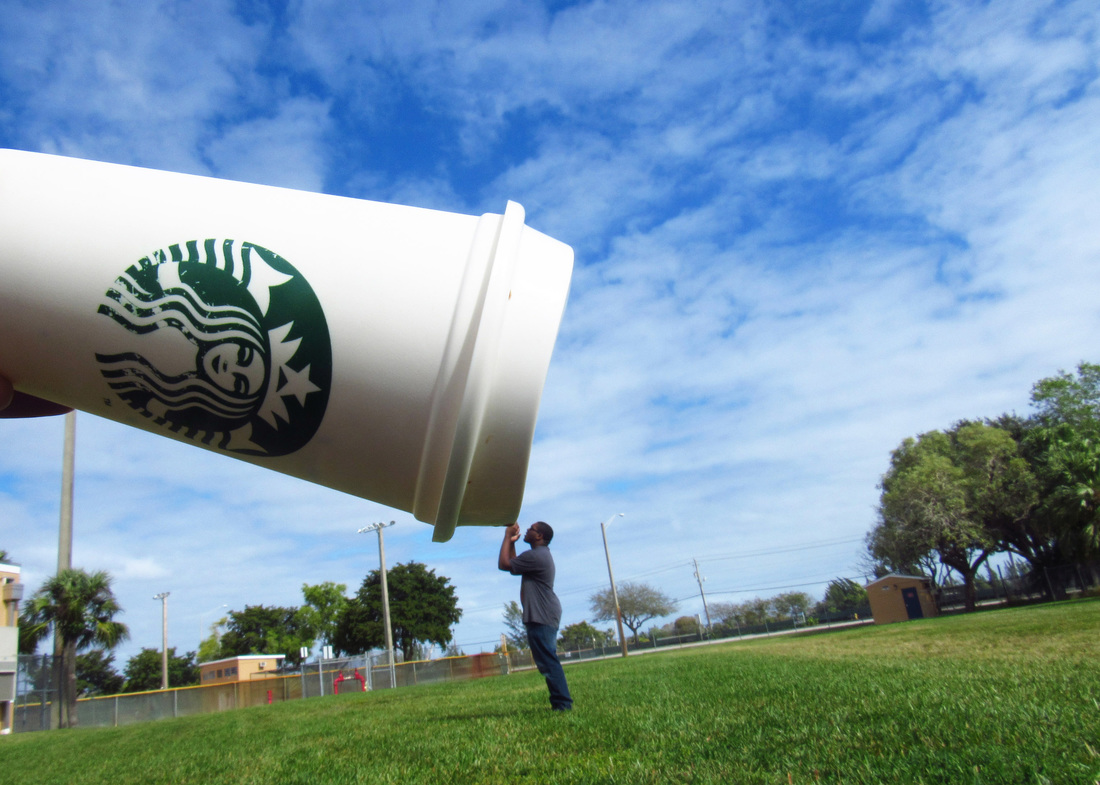
- Set up a scene for a photo that creates forced perspective and see who can create the wackiest scene.
For middle school
I have been thinking about how to balance the limited art resources that they may or may not have at home with them,
with the wet and dry media skills I am trying to develop in them to prepare them for level 6 of the visual art curriculum.
This has involved really going back to basics and thinking what can be done with pencil, pen and paper, and possibly what might be lying around in the pantry.
I am really, really grateful that I had the foresight to purchase some art making kits from Joe at HomePrint in Fielding.
This was initially for me to get through some stressful times, but has turned out to be quite fruitful for coming up with ideas for middle school art (and possibly even year 11, if the student hadn't retrieved their art kit from school in the days leading up to the lockdown).
A really simple, yet effective idea is cutting a paper stencil, taping this to another sheet of paper and drawing into the negative space.


Students could use this technique to zen doodle and de-stress or share with the class what is happening in their bubble.
Another neat idea I pinched from a colleague of mine was a food colouring and drawing exercise. All students will need is paper, something to wet the page with, a few drops of food colouring, and something to draw into it with once the food colouring has dried.
The first step would be to wet their page. If they have a brush, this is great, otherwise they need to find some other way of wetting their page so that they have a regular shape on it (perhaps over a sink, hold a piece of paper firmly over a mug of water. Quickly flip it over so that the paper is wet in a circle shape and then back up the right way). Then while the page is still wet, drop a few droplets of food colouring onto the damp paper. The food colouring will mostly just stick to the wet page.
Then leave the page to dry (with something heavy at either end of the page to stop it from curling up).
When the page is dry, doodle into the spaces where there is less colouring. This could be a zen-tangle and quite abstract, or it could be a more organised doodle landscape. For an extra challenge try drawing something you can see in your bubble into the artwork.


(acknowledgement given to M Timutimu, who made these artworks)
For my senior students, it has been a good opportunity to put together some art history tasks that relate to their portfolio work, as many have their art kits but are needing to ration what they do have.
Students get extra literacy credits in a time where their teachers might be pushed to get them through their useful programme of learning and I have come to realise how practical and useful the art history standards can be for visual art students. Win, win.
I'm not going to lie. It has been a lot of work to tailor the art history standards to all the different levels and fields that I teach and their interests.
This was my life last week. I feel like it will be really beneficial in the long run though.
I've also had to rethink my tried and tested painting & printmaking programme for level one students. It's a bit hard to make this happen when there is no printmaking press! Fortunately at level one, students can do printmaking, painting, sculpture, photography or design - they are assessed against general visual art making principles. It really has been a case of trying to put myself in my students' shoes and thinking, what can I do given the resources that I have at hand.
Time will tell, the impact that this has on students' learning.
Sunday, 15 March 2020
Setting the course for my 2020 inquiry journey
Teacher inquiry is a funny thing isn't it. For many teachers it is the thing that they love to hate, an exercise in compliance.
But for me I think I would be reflecting on my teaching whether it were a part of my appraisal or not. Since undertaking a Master's study in 2018 I see the value of practitioner led inquiry. I think that is the key. Practitioner led. If I were to be told what my goals were, or have parameters placed around what my goals could and couldn't be, I would quickly rebel.
For me inquiry needs to be timely and relevant. It needs to address authentic issues within my context, not create layers of extra work and bureaucracy.
Earlier in the year I set my professional inquiry goals, thinking back to last years' inquiry and the needs identified.
For my face to face class, I decided that it was important to develop reflective capabilities in my junior and middle school students, and as I reflect on this goal amid schools put together plans for how they might deal with covid-19 should it develop in our community, it seems more relevant than ever.
If my students aren't able to be in class, or if indeed the school is unable to be open physically, I need to ensure that my students are able to continue engage with their learning and take ownership of their learning, without their teacher in their faces telling them what to do.
For my online class, my goal is to use a knowledge building approach to engage online learners. This has the potential to be quite a challenging goal, if students join my online class for a period of time while they are unable to access their face to face classes. This is a possibility if their school isn't equipped to deliver curriculum digitally and engage with their students by distance. I would have to think quite carefully about how I manage this, as there is a whole lot that I weave into the background of my online class to ensure that students are connected as a community and engaging with each other in and out of our scheduled VC time. Creating a safe space to work as a class, takes a fair bit of intentional learning design.
I also think that there is a great deal of potential to model and share quite innovative practice to a wider 'audience', there is potential for online teachers to be leaders in terms of pedagogy, here.
But for me I think I would be reflecting on my teaching whether it were a part of my appraisal or not. Since undertaking a Master's study in 2018 I see the value of practitioner led inquiry. I think that is the key. Practitioner led. If I were to be told what my goals were, or have parameters placed around what my goals could and couldn't be, I would quickly rebel.
For me inquiry needs to be timely and relevant. It needs to address authentic issues within my context, not create layers of extra work and bureaucracy.
Earlier in the year I set my professional inquiry goals, thinking back to last years' inquiry and the needs identified.
For my face to face class, I decided that it was important to develop reflective capabilities in my junior and middle school students, and as I reflect on this goal amid schools put together plans for how they might deal with covid-19 should it develop in our community, it seems more relevant than ever.
If my students aren't able to be in class, or if indeed the school is unable to be open physically, I need to ensure that my students are able to continue engage with their learning and take ownership of their learning, without their teacher in their faces telling them what to do.
For my online class, my goal is to use a knowledge building approach to engage online learners. This has the potential to be quite a challenging goal, if students join my online class for a period of time while they are unable to access their face to face classes. This is a possibility if their school isn't equipped to deliver curriculum digitally and engage with their students by distance. I would have to think quite carefully about how I manage this, as there is a whole lot that I weave into the background of my online class to ensure that students are connected as a community and engaging with each other in and out of our scheduled VC time. Creating a safe space to work as a class, takes a fair bit of intentional learning design.
I also think that there is a great deal of potential to model and share quite innovative practice to a wider 'audience', there is potential for online teachers to be leaders in terms of pedagogy, here.
Subscribe to:
Posts (Atom)